Navigating the Revised OSHA Hazard Communication Standard: Top Industry Concerns and the Final Verdict
Written By: Atanu Das on Wednesday, July 22, 2026
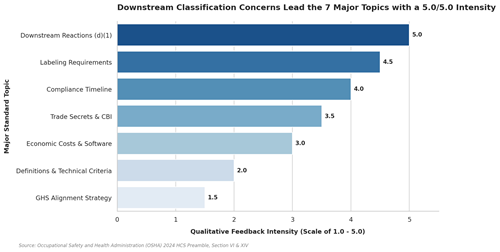
As the standard moves toward implementation, several key areas of concern emerged from industry feedback. Here is a breakdown of the top concerns identified by trade groups and how OSHA ultimately responded to them in the final standard.
1. The Downstream Reactions Debate (Paragraph (d)(1))
The proposed requirement for manufacturers to classify hazards resulting from chemical reactions downstream became the biggest flashpoint. Commenters from the Plastics Industry Association (PLASTICS), the American Chemistry Council (ACC), and the American Composite Manufacturers Association (ACMA) argued that trying to predict every conceivable downstream reaction was a "monumental, infeasible, and counterproductive" burden.
The ACC raised concerns that compiling this information would require 16 hours of update time per SDS, adding 17,500 to 70,000 hours of work across the industry.
- The Verdict: OSHA agreed that the proposed text was unclear. In the final rule, OSHA clarified that upstream suppliers are only responsible for evaluating hazards associated with the chemical’s intrinsic properties under known or reasonably anticipated uses—not every conceivable downstream scenario.
2. The "Released for Shipment" Date Pushback
To help track inventory, OSHA originally proposed requiring a "released for shipment" date on shipped container labels. This was heavily resisted by industry groups. The National Propane Gas Association (NPGA) estimated that adding this date would cost a staggering $55 million to update labels across 40 million small propane cylinders and 10 million larger tanks (costing $1.00 to $1.50 per label). Others warned it would trigger severe space constraints on small labels and cause confusion with other date requirements (like expiration or DOT dates).
- The Verdict: OSHA found the industry's arguments compelling and completely removed the requirement to include the release for shipment date on the label.
3. Timelines and the "Supply Chain Cascade" (Paragraph (j))
Timelines for compliance caused significant anxiety. Under the initial proposal, manufacturers had a tight window to comply. Downstream mixture manufacturers argued they could not update their safety data sheets until upstream chemical suppliers classified and sent updated data—creating a critical supply chain lag.
- The Verdict: OSHA agreed with the need to prevent a chaotic transition and extended the compliance timelines. The final rule implements a tiered schedule, providing 18 months for substances and 36 months for mixtures.
4. Trade Secrets & Prescribed Concentration Ranges (Paragraph (i))
To align with Canada, OSHA proposed using prescribed concentration ranges when claiming a trade secret. Some trade groups feared these ranges were too narrow and would expose highly sensitive intellectual property to competitors.
- The Verdict: To ease this concern, OSHA added a new paragraph (i)(1)(vi) allowing manufacturers to use narrower ranges than those prescribed. This successfully protects confidential business information (CBI) while maintaining alignment with Canada's system.
5. Refining the Definition of "Combustible Dust"
The technical definition of combustible dust was heavily scrutinized as too broad and confusing, specifically the use of the word "explode". Commenters argued it failed to account for necessary ignition factors and conflicted with National Fire Protection Association (NFPA) standards.
- The Verdict: OSHA refined the final definition to replace "explode" with "explosion hazard" and "particles" with "particulates" to better align with NFPA standards.
The Bottom Line
While the transition to GHS Revision 7 requires real administrative work—with some associations estimating the cost of updating a single SDS at $400 to $1,600—the final standard shows that OSHA actively listened to industry feedback. By adjusting timelines, clarifying downstream hazards, and deleting the shipment date label requirement, the final HCS balances robust worker protection with practical business feasibility.